Showing posts with label Design Thinking. Show all posts

Thursday, August 24, 2023

The Engineering Design Process #MakerEd @AdobeforEducation #AdobeEduCreative

Hello friends! I wanted to share this example I made using Adobe Express that used Animate from Audio. It is super simple to use! You choose a character, choose a background, and record your audio. Adobe Express does the rest! I wanted to create a short video that explains the Engineering Design Process for my students in design class and this is what I was able to create. My favorite part is the last few seconds where I was able to use Adobe Express to have video running on different layers at the same time. It was just a fun think I wanted to see if I could do and I could! Check out it out below or click this link!


Hugs and High Fives, 

N Provenzano

Monday, March 6, 2023

Using Minecraft to Design Amusement Parks @PlayCraftLearn #MakerEd

My Innovation and Design class has been a work in progress since I created it in 2020. Lots of ups and downs as I tried to figure out the balance of all of the different types of projects I wanted students to explore over the course of the trimester. I feel like I finally landed on something that is working and I wanted to share it here. 

I wanted students to think big for their Minecraft project but felt like I never had the time to give them because of the other projects. I also noticed that there are some projects that require waiting and do not take the entire class period. For example, making the cutting boards requires wait times as boards are cut and glued together. I don't want students just sitting and waiting for projects to glue, so I realized that a long-term Minecraft project might be the thing I have been looking for to solve my time problem. In retrospect, it is a pretty simple solution to the problems I was having, but, sometimes, things just take longer to click. 

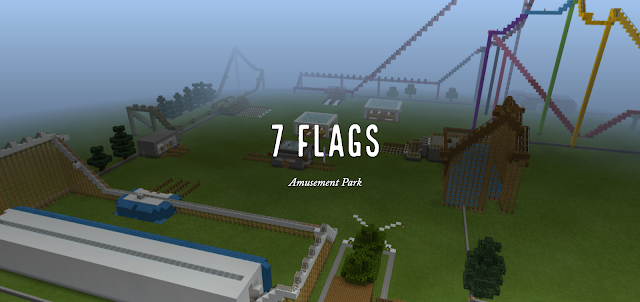
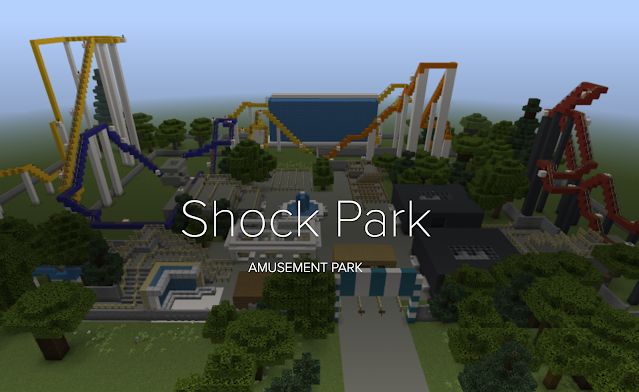
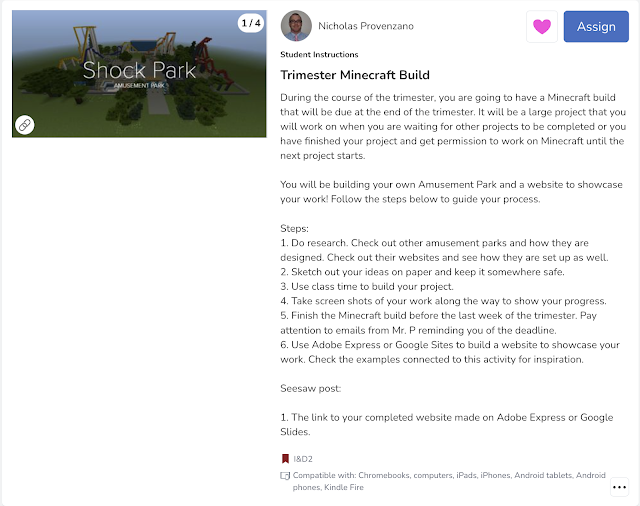
I introduce the Minecraft assignment to students at the start of the trimester and let them know it will be due at the end of the trimester. Students will be given days during the class to work on it, but they will also have time in other classes when they are waiting for projects to print on the 3D printer, be cut on the laser cutter, or finish glueing. These times will keep them active in the design and build process while waiting for other projects to finish. I rolled this out for the past trimester and I think it worked very well. Students worked here and there on their build and created some amazing projects. I think I would give more in class time on the assignment as some students felt rushed at the end, but that might also be just Middle School time management issues. The start of the third trimester will give me a chance to tweak anything as I have another go at the approach. Below you will find the activity I assign on Seesaw and a few of the completed projects you can click on and will be taken to their sites. Some students used Adobe Express to create a website and others used Google Sites. 


The Google Sites created below can only be accessed by students and staff from our school. 
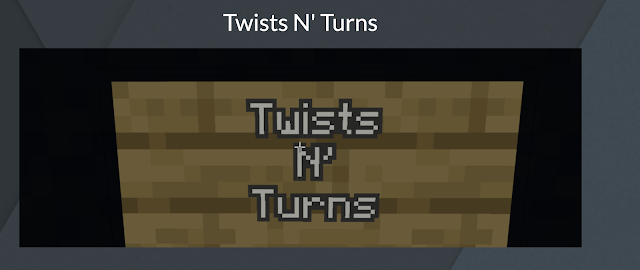

The students were excited to showcase their work and there were great conversations about what goes into a website that is trying to sell people on what they have to offer. Spelling and grammar conversations were had as students talked about what a website that is filled with errors might say about a business. Most of all, time management was a big part of the conversation since many students planned for something much bigger, but underestimated the time it would take to complete much of their park. My class is about failure as much as it about design and creation. Learning those hard lessons on time management and completing tasks in a timely manner are tough lessons to teach, but learning them in an environment where they do not have to be afraid of failing their assignment or class because they tried something big is important to me. (My class does not have homework or grades to push student to try big ideas and see how they work.)

Like many other teachers, I know that my class is a constant work in progress, but I wanted to share this win because sharing good things once in a while is good for a teacher's soul. 

Hugs and High Fives, 

Nick

Wednesday, April 13, 2022

Coolest Projects from Raspberry Pi #MakerEd

If you are looking for a fun way to bring a design challenge to your students, please take a moment to check out Coolest Projects from Raspberry Pi.


Coolest Projects provides all of the information a student and a teacher needs to be successful. The mentor guide really helps the teacher through the process. I love the student guide that was created that helps walk the students through the design process. From ideation, creation, testing, and reflection, the student goes through the entire process following the guided steps

Whether creating something using Scratch or something that requires physical hardware, there are plenty of different categories that students can submit their project to for consideration. I will be rolling this out to my 6th grades in the next week and I can't wait to see what they come up with for Coolest Projects

The deadline for sharing the projects for judging is May 11th. I am looking forward to seeing all of the amazing projects this year. 

Hugs and High Fives, 

N Provenzano

Thursday, February 17, 2022

Breaking A Few Eggs #MakerEd

One of the things that I have always loved about MakerEd is the mistakes that are made along the way. Mistakes are an important part of the learning process, but grades have made them feel way worse than they should be. The best metaphor for this is the egg drop project my 6th graders work on for Innovation and Design. 

Students are given a bag of supplies and are tasked with making a vehicle that can protect an egg from a one story drop from a balcony. Students work to design and build their vehicle and are even given some plastic eggs to use a test dummies for practice drops. However, when it comes time to drop the real egg, some students are scared. They do not want to see a broken egg. Even though they will not receive a bad grade for a broken egg (my class does not have grades) and they will be given a chance to redesign and drop a second egg, some of those students are hesitant to drop because of what failure will physically look like; a destroyed egg. 

Some students love the idea of dropping an egg and seeing a very real success or failure. The binary way of looking at it works for some students. If it broke, they need to figure out how to fix the mistake so the next egg doesn't break. If it is unbroken, they are reassured that their design worked. While not every assignment or project is as clear as this, it is a nice way of looking at work students do in school. 

If the egg breaks, just have another go at it and try to get it right. That approach works for every assignment. I ask students to not be afraid of a broken egg. Just go for it as long as they commit themselves to finding out why the egg broke and work to make sure the same mistakes do not happen again. With that approach, a few broken eggs will be expected and students will not be so hesitant to try. 

Mistakes are how we learn and we want students to be more comfortable with them. Sometimes is takes a few broken eggs for them to see this. 

Friday, March 19, 2021

Minecraft and Literature #MakerEd #PBL

 I wanted to share a fun project that I created for my students when I had to be out of class for a couple of days. My middle school design students were working on a Design Thinking project, but could not work on it because the world was with me on my computer. I needed something for them to do that would have them think and create. It came to me quickly and I think it is going to turn out wonderfully. 

I gave students links to "The Raven" and "A Tell-Tale Heart". I like Poe and these were chosen for that reason and that they are both very short. I wanted students to be able to listen/read them in class. I used the YouTube videos of Christopher Lee reading them and you can find them both below. 


After reading/listening to these two pieces, students have to choose a scene from each that stood out to them and design a version of it in Minecraft. Students would start with a paper design and then move to Minecraft Education Edition to fully flesh out their design. They would post their design and multiple images of their completed build in SeeSaw with explanations of why they chose the scene and how they built it. Here is the example I created for the students to see what I was looking for from them. 

My sketch is very rough, but it conveyed the idea I had. 

I really thought I did a good job showcasing the eye here. 

The full scene from afar. 

If you want to see my SeeSaw post, you can check it out here. 


These students are very gifted builders and I can't wait to see what they can create using Minecraft Education Edition. I think this is a great way to allow students to demonstrate understanding and meaning of texts in a way that is comfortable to them. Imagine students building entire towns or homes of characters and explaining their symbolic value in the story. Themes, motifs, symbols, characterization, and much more could be discussed in depth through their creations. I think there is so much here worth exploring and I would love to hear how other ELA teachers are using Minecraft to connect their students to the reading. Tweet or tag me @TheNerdyTeacher and we can connect!

Thursday, January 21, 2021

#PBL and #MakerEd Anthem

It might seem silly, but I feel like everything has an anthem. A song that represents the essence of that particular thing. It is not the same song for the same thing for everyone, but it is a song that connects a person to that thing in a personal way. There is one song that is my Project Based Learning and MakerEd Anthem that I want to share with you. It is playing on my Instagram post on a project that I finally completed after multiple design and prototype failures. 


It might seem silly to some people, but this song just gets me going whenever I hear it. Sometimes, I play it in class for the students before a project. The song might be too on the nose about trying and failing, but I still find it inspiring. Do you have a song that you love that is your anthem? Share it on Twitter or in the comments below. 


Monday, February 24, 2020

Don't Waste Money on a Makerspace... #MakerEd

...if you are not going to support your staff with professional development.

One of the things I encounter on the internet and in my travels are schools that have spent lots of money on makerspaces, but have not provided a framework of support for teachers on how to get the most out of them. I have seen the same thing done with interactive whiteboards, chromebooks, and other pieces of technology rolled out into schools. Makerspaces require much more support than one would think. It is because teachers need to shift their instructional practices to truly get the most out of the new space.

Project Based Learning and Design Thinking are a couple of approaches that can help teachers truly understand and lesson plan in ways that will have students utilize a makerspace. It usually starts off with teachers creating lessons that just allow students to make things at home or in the classroom. As their creativity increases, there will become a greater need for a variety of tools. That is where a Makerspace can truly have a wonderful impact on instruction.

If you are considering add a makerspace to your building, please consider finding ways to provide professional support for the instructional practices that teachers will need to best utilize the space. Trust me, you do not need to spend an arm and a leg to do it either. 

Thursday, October 24, 2019

The Pressure of Failing #PBLChat #EdChat

One of the things I have learned over the years with project based learning is that some students are willing to take a risk and try something new to demonstrate their understanding of a topic and others will play it safe and stick to tools and resources they are comfortable using. There were many factors that contribute to playing it safe or taking a risk, but in school, being graded has a large influence on these decisions. Since removing grades from my new elective, Innovation and Design, I'm starting to see how much an impact grades were having on trying new things.

Students have been working to create prototypes of objects from the story, "There Will Come Soft Rains" by Ray Bradbury. A student was very frustrated over the amount of time it has taken him to craft some type of cover for a Sphero so it could drive around easily and look like a mouse from the story. Time and time again, the student has failed, but gets back to the design and tries again. At the start of class I asked the students why they are willing to keep trying over and over again and they simply said because it wasn't going to hurt their grade if they tried something and it didn't work. They still have a deadline, but they can try crazy ideas that might work without fear of getting bad grades.

Giving students a space to try and fail without punishment is so important for students. They are given the opportunity to push themselves, explore new concepts, and see what they are capable of at the end of the day. A 6th grade student spent five 75-minute class periods figuring out how to use Vectr.com to design 2D images for the laser cutter to create a windows that could stay opened. After 5 or 6 failed prototypes, she was able to get the right size for everything she needed and then decided to add acrylic windows. Here is a shot of her work.


Kalie expressed some frustration that it took her 5 class periods to design something and cut it on the laser cutter in one day, but I told her she spent those days learning how to do something and then she did it. That's exactly what school is supposed to be about. As a 6th grader, she is now able to design to use the laser cutter and then set up the machine and cut on her own. This was all driven by her want to design the windows from the story. She was not chasing a grade and probably would not have chosen to learn an entire new program if there was a grade at the end of the project. This is the example, along with many of the other projects in the class so far, that shows me the extended value of Project Based Learning and a grade free environment. 

My new class still needs some fine-tuning, but I am confident the basic structure of PBL and no grades is going to create some amazing opportunities for student learning moving forward. 

If you are interested in connecting about bringing PBL, Design Thinking, and more to your school, please feel free to reach out to me at OneNerdyTeacher@gmail.com.

Tuesday, October 8, 2019

No Grades and The World Did Not End #MakerEd

I started a new class this year in the middle school. It is a design and innovation class that is supposed to help students explore problem solving and critical thinking skills. One of the things that I wanted to really explore was a class free of grades. I was nervous about how this might look because I have never done this before and I was scared about how students and parents would react, but I was surprised to find that the world did not end.

We have completed two projects in the class and are starting our third project this week. The main reason I wanted to avoid grades was because they can be a hinderance to students who are afraid of trying something new or risky because it could hurt their grade. Even though I assured kids no grades would be coming, some were still very hesitant to "go for it" on the first project. Using Design Thinking to create a home for a friend in Minecraft was something I hoped would ease students into the process of designing and building with a sense of freedom. Some students pushed themselves and others took the path of least resistance. I was worried that these students would always just do what they had to and try to get by with minimal effort. I decided to use the 2nd project to really push those students on their design and builds.

Students were asked to design a shoe using 4 pieces of newspaper, 1 foot of duct tape, and 1 foot of yarn. Once it was designed, they needed to create an ad for their creation. Some students really went for it and created some amazing, functional footwear, while others settled on a slip on shoe for their first design. I could have let it go, but I really wanted to push them to think bigger. I let those groups have a chance to redesign their entire shoe with new supplies if they wanted. I told them to just go for it because they are not getting a grade on this project or for the class overall. Every single one of them chose to go at it again instead of just sitting and "being done". It was awesome.

I could see that students have started to become more comfortable in trying new things and are not letting the idea of grade impact their choices. The next project students are going to design elements from Ray Bradbury's short story "There Will Come Soft Rains". I think I have built the capacity to try the tough things and learn without the fear of failing grades. 

Friday, September 13, 2019

Minecraft and Design Thinking #MakerEd @PlayCraftLearn

My first lesson for my Design and Innovation class needed to be something that would engage the students immediately. Minecraft is huge in our Middle School and I thought that would be a wonderful way to get students thinking about design. Luckily, we have Minecraft Education Edition rolled out for every student in our Middle School.

The goal of the fist design challenge was to design a house for me. The students were not allowed to ask me any questions. They just had to build me a house based on what they think I might like. They were given 20 minutes to put together a prototype. The kids were understandably frustrated, but they all worked very hard to create something that they hoped I would enjoy.

We discussed the mostly completed houses and I would tell them what I did and did not like. Next, I allowed them time to ask me questions and dive deep into what I do like and what I need in a house. The reason they had to build the first house without the questions was to show them the value of listening and asking questions.

In design thinking, you want students to have empathy for the person they are designing and you can do that with the help of asking the right questions. Having the students see the value of asking questions allowed them to embrace this part of the design process. Kids love to jump to the ideation portion of design thinking because it is more fun, but they really need to spend time focusing on empathy.

The kids asked so many amazing questions and really focused on what I liked to do with my spare time and how I move about my own house. I could see they really were looking for questions that didn't just give them one answer (Do you like carpet?), but for questions that could provide a multitude of information (What do you do when you are bored at home?).

Minecraft is a wonderful tool for this intro to design thinking for students because it was so easy for them to log in and start crafting. Students were put up houses of all different shapes and sizes in a matter of minutes. That is what I was really hoping was going to happen and it was awesome to see them all working and helping one another. No grades really seems to help them take their time and try different things. One student built a red stone operated door that was protected by a golem. Ya, that was a weird sentence to write.

After their second version of the house, I walked the students through the rest of the design thinking process following the handout created by the Stanford d. School. I modified their handout that can be found here.  Next week, students will pair up and go through the design process with a partner and try to create the perfect vacation experience in Minecraft. This is their chance to really stretch and see if they can find empathy for their partner and really build something amazing for their partner.


Here is a quick example of using SeeSaw to post images taken from Minecraft to demonstrate what was built.


Stay tuned for more exciting adventures in the design class!


NP

Tuesday, September 10, 2019

Back to work #DesignThinking #PBL

Today I go back to the proverbial front of the classroom.

Over the past two years, I have been working with teachers and building a makerspace for our school. It has been a fun experience, but I have always missed out on having "my" class and the challenges that come with it. Today, I will be teaching a class I will be building from the ground up.

Since I started at University Liggett School, there has been talk about creating a class for the 6th graders that would focus on problem solving and critical thinking. There was talk about a Makerspace class, but I did not want to teach a class on how to use 3D printers. However, teaching students how to approach problems and use different tools to create solutions sounded amazing.

I spent the past 6 months diving into what a class that is a trimester long might look like and I found myself drawn to the Design Thinking model of problem solving to create a base for the class and using that to jump to other design ideas. As a trained ELA and Social Studies teacher, I feel a bit out of my element, but excited to learn with the students and see what happens. I'm also excited to implement things I have always dreamed of doing in a class.


  • Mindfulness - I will be starting each class with a few minutes of mindfulness. I am using the Calm app on my phone. My class is after lunch, so I want to take a few moments to calm the bodies and mind before asking them to dive into problem solving and critical thinking. I'm nervous to as Middle Schoolers to sit quietly and look inward for relaxation, but I feel it is important and I'm going to give it a try. 
  • Portfolio/Project Based - This class is going to be based on what they create. Everything will be stored in SeeSaw and that is where my feedback will live as well. Students and I will be able to have an ongoing dialogue about their work and how it evolves over the course of the trimester. 
  • No Homework - I will not assign anything that requires students to work at home. My goal is to create an environment where students are excited about their projects and want to work at home and share with their family. I refuse to add more work to their busy schedule at home. 
  • No Grades - I will not be giving grades for this class. Students will have a 1 under the assignment if it is completed and we have met to discuss it or a 0 is the project has not been completed and we have not conferenced about it. I feel like giving a grade to a student who solves a problem one way and a different grade to a student who solves it another way is just not what this class is about. I also think by getting rid of the grades, students will be more likely to try big ideas and embrace failure instead of taking the easy route to finish the work. I could be way off here, but I love that I get to try. 
I have some ideas for projects that might be super fun, but I will have to roll them out and see what the kids think. I will be starting with the Wallet Challenge from the Stanford d.school and then moving to a Minecraft for Education challenge to create the perfect vacation destination for a partner. I will be trying Chindogu with my students to bring a fun, light approach to design and I'll see how students might repurpose underutilized areas of the school. I also have an idea for students to create a small line of products that people might want to buy and setting up an Etsy shop to see how that goes. IDK. Lots of ideas and I can't wait to see how much of it works and how much of it blows up in my face. If it does, than I'm modeling exactly what I want to see from the students. 

Wednesday, January 9, 2019

Getting Your Hands Dirty #MakerEd

I have spent the last few days working with 9th grade students in the Makerspace. I was asked to give them a design challenge and go over the Design Thinking process. It is an addition to the 9th grade curriculum that I'm very happy to see take place.

I put together a variation of the Toxic Popcorn Challenge. Students need to use the Design Thinking process to try and transfer corn kernels into another container without entering a 4 foot radius around the toxic container. They are allowed to use anything they can find in the makerspace. Traditionally, this project is given over the course of a class period and the supplies are limited. Part of the project was to have students explore the makerspace and really see what it had to offer. Here are some pictures that showcase what the students worked on so far.


There are so many different approaches to the challenge it has been great to see the students dive into the project. So are making giant scissors, others are focusing on tension strength to hold the containers, and another group has focused on a giant clamp. It is so cool to see the problem solving and design going into their potential solutions. 

The majority of these students have never held a drill or saw for a project. It was so awesome to be able to teach a student how to use Mitre Saw and a Power Drill. Changing bits on a drill and adjusting bit size to get the right size screw through are not skills you just pick up randomly. These students had no problem getting their hands dirty and that is the key. I'm so proud of our school, University Liggett, for working hard to create an environment that focuses on creating makers and learners and not just grade earners. These students worked into their lunch to finish part of their project. They wanted to learn how to do the things to solve their problem. Students need to get their hands dirty to learn sometimes. Do that, teachers need to get their hands dirty as well. 

I can't wait to share the end products with everyone. Keep an eye on Instagram, I post maker work there often.  

Hugs and High Fives, 

NP