Showing posts with label Maker Mentality. Show all posts

Tuesday, February 8, 2022

Recovery with #MakerEd

It's been a bit since I have shared anything on the website and that is because I have been recovering from a cardiac event. 

tldr; Had a serious heart event. On the mend now thanks, in part, to the calming nature of making.

Over a month ago, I experienced right chest pain and arm tingling after a workout. Decided to go to ER, but almost turned around because it felt better.

Decided to go in since I was there. I was able to be seen right away and they did some tests. Blood tests showed high Troponin levels. These are high if you’ve had heart trauma. 0-80 is normal. I was at 800, then 3,400, and then 32,00.

They called in the cardiac team and rushed me to the Cath lab to stick a line in my wrist to my heart to figure out what was going on because other tests showed I was supposed to be ok. Turns out I suffered a rare SCAD event.


These events are extremely rare in men. It’s why all of my symptoms and tests were confusing. I was placed on blood thinners and other meds to prevent clots and other nasty things. I stayed in observation for a few days before another Cath visit to see if I’m healing.

The 2nd Cath showed things were going in the right direction. My Triponin levels were dropping and no signs of clots. I was able to go home after 5 days and I saw my cardiologist. I was given two weeks of bed rest to heal. During that time, I spent lots of time making things. I did lots of doodling and spent time with LEGO kits. I needed to do something, but also keep my blood pressure down. I fell back to the things that I loved. Playing with Python code, exploring Raspberry Pi projects, designing in 3D, and other maker outlets was a great way for me to keep my mind active, be creative, but also take it easy. There are great studies out there that support creativity and its positive impact on mental health issues. Here is one by Connor, DeYoung, and Silvia "Everyday creativity activity as a path to flourishing". There are others worth reading if you are interested in going down that rabbit hole like I did. 

I will have missed 3 weeks of school by the time I came back. I will be on blood thinners for the next three months and I could not come to #FETC22 or #TCEA22. I have been looking forward to these events because I have missed seeing so many of my friends in person. My mental health took a major hit when I realized what I was going to miss. Making helped me deal with my emotions during this time.  

I started cardiac rehab last week and look forward to a return to normalcy as I build back endurance.

I look to be right as rain by the Spring and I’m excited about my Summer opportunities that have started to emerge. #ISTE in NOLA will be great. I can't wait to see all of you after a couple of years away. 

The last thing I want to share is to tell you to listen to your body. Get that thing checked out. I was lucky the ER was not slammed for the first time in 9 months and I was seen right away. If I had to wait, I might not be here. Take care and I hope to see you soon.

Hugs and High Fives, 

NP

Monday, March 25, 2019

Season 2 of The Maker Mentality Podcast #EdChat

Hello everyone!

I'm so sorry it has taken this long to release the first part of Season 2 of the Maker Mentality Podcast. Life has been feeding me a steady diet of curveballs and I finally just decided to release the first three episodes today and I can release the others when they are done.

This season is all about creativity. I have asked my guests about their thoughts on what creativity means to them and what role it plays in learning.

These three episodes feature some of my favorite people sharing great ideas. Check them out here or anywhere else you can find podcasts.

Jessica L. Williams


Meenoo Rami


Andrew Collins


Stay tuned for more episodes in the coming weeks. 

Hugs and High Fives!

NP

Thursday, December 13, 2018

Season 1 of The Maker Mentality Podcast #MakerEd

If you are looking for some podcasts to fulfill your Maker needs, The Maker Mentality is exactly what you need.

The first season is available to binge right now! Season 2 will be dropping in the New Year and it will be filled with some amazing guests.

Check it out here, or you can go to the following podcasting places to hear The Maker Mentality.

Apple Podcasts
Google Podcasts
Spotify
Stitcher 
Radio Public
Pocket Casts
Breaker


Thanks for listening and let me know if there is anything you'd really like me to cover or someone you would like me to have a conversation with in a future episode. 

Hugs and High Fives, 

NP

Tuesday, October 23, 2018

It's Global Maker Day #GlobalMakerDay #MakerEd

I'm so excited for Global Maker Day! One day to recognize the amazing work being created by students and teachers all over the world. I've been so lucky to be in a position now for over a year that supports Making in all of its forms. As the Makerspace Director at University Liggett School, I have seen students and teachers design and make so many awesome projects. Here are just some of this cool things created in the Knights Forge Innovation Lab.


Global Maker Day is about giving everyone a chance to share their stories about why Making is so important in and out of the classroom. Adults need to make and model for students who have the itch to create, but are not sure where to start. The school needs to support a culture of making, a Maker Mentality. Without it, students and teachers will not feel as empowered as they could to create and share with the world around them.

As humans, we are makers. We have always been makers and that is how we have accomplished the most amazing things in human history. The minute we become a civilization of consumers only, we are doomed. Let's make time for making in our classrooms and at home. Have a great Global Maker Day everyone!

If you are interested in starting your own Makerspace or diving into the culture of the Maker Mentality, you should check out my two book on Amazon. They are a great place to start your Making journey and have been used as part of school book study groups. If you have any questions about my books, making, or just want to share an awesome story, please let me know.

Hugs and High Fives,

Nick

Monday, October 8, 2018

Writing IS Making #MakerEd #CSforAll

The more I have spent time sharing Making and Makerspace with people, the more I get to reflect on those conversation and see how others perceive the act of making. I also spend time thinking about my own practices and how I used to teach in my English classes. The one thing that stands out is that writing is an act of making that should be in the same conversation as coding, 3D design, and other forms of creation.

When I work with students and teachers, the focus of making is not learning tools. The focus is on designing to meet the task at hand. The process looks a little like this;

1. Identify the problem or question

2. Generate ideas to address the problem/question

3. Prototype one or multiple of those ideas

4. Evaluate the prototype and have others offer feedback

5. Iterate the prototype or start over with a different concept

6. Repeat steps 3-5 until a final concept is found.

7. Take prototype and turn it into a final product.

8. Share your final product

(Editor's Note: Now, these are not the end all be all steps in the making process. Every person with have their own steps and some mini-steps that fit in here. There are things I might not have written that I take for granted as part of one of these steps. The point I'm trying to get at is that I don't want people to feel that this is a set in stone guideline on how to make.)

These are steps I present to teachers as they plan lessons that involve Project Based Learning and will require students to create an artifact to demonstrate understanding. I also use these steps to support students as they explore creating something that really want. As I started to articulate these steps, I noticed something that connected to my English background. This is the very similar to the writing process.

For writing, I would ask my students to follow this process when writing,

1. What is the question you are being asked to address or the assignment you were given?

2. Generate different ideas to address the topic of this paper or assignment.

3. Put together a rough draft of one of your ideas.

4. Review your rough draft and share with others for their feedback.

5. Make corrections and change the piece based on feedback and observation.

6. Repeat steps 4 and 5 until a final draft emerges.

7. Submit final draft to class.

This writing process can work for a formal essay, a short story, a poem, or any other form of writing. When people talk about STEM only used for Makerspaces, it really bothers me because the Arts belong in a Makerspace. We need to bring all of these pieces together to form STEAM so that all students can feel like the type of making they want to do is valid.

For ELA teachers, I want you to look at this model and see how similar it is to the writing process and I hope you feel more comfortable trying to integrate other forms of making into your classroom. If the students mirror the writing process, they can follow the maker process because they are one in the same.

This one of the ways that The Maker Mentality works across curriculum and can help create a culture that all students and teachers are makers that just use different mediums. So, before you dismiss writing as an act of making, focus on the process and not the tools. I think you will see that making is all around you. 

Wednesday, September 19, 2018

Assessing Making #MakerEd #MakerMentality

The other day, I was doing a webinar for littleBits and I was asked a question I often receive when talking about Makerspaces.

"How do you assess the making that happens in a Makerspace?" This question and slight variations often come up because we are a system that can only understand something if it is assessed. For somethings, I understand the need to assess skills to see improvement. Assessing writing skills and reading skills can help a teacher better support a student in their class. If someone wanted, they could create assessments for soldering, wiring, coding, etc. Every aspect of a Makerspaace could be dissected and assessments can be created. However, that is the antithesis of making.

A Makerspace is another tool that students and teachers can use to accomplish different tasks. Project Based Learning and Makerspaces go so well together because the assessment in PBL is whether or not students demonstrated understanding of the topics assigned. They can do that through so many different parts of a Makerspace. The assessment given by teachers should not be about how well they used an LED or Raspberry Pi, it should focus on how well the students were able to demonstrate understanding.

Badging systems are in place in many spaces and we are looking to expand our badging system this year, but badges are in recognition of student skills, not an assessment. I know this might be semantics, but it is about the mentality of the makers that makes the semantics work. The benchmarks to earn a badge are there for students as they learn different skills. It is not something imposed on them with strict timelines. Students demonstrate their skills when they feel they have mastered them and they receive a badge to recognize that learned skill. No fear of failure or lowering of the GPA. They are learning because they want to learn.

If your focus is on how to assess making in a makerspace, you have lost what it is that makes a makerspace so special. It is supposed to be a place where anyone can come and explore design and creation without the fear of judgement. The minute you start putting assessment around making, you strip it of the purity of learning for learning's sake. With so many things assessed and measured, let's keep the makerspace free of archaic measurements and let people make in peace.

If you want to learn more about creating a specific culture around your makerspace, consider picking up The Maker Mentality to help make that transition happen. If you need to focus on building the space, then Your Starter Guide to Makerspaces is what you need. 

Saturday, July 21, 2018

It's About More Than A Computer Board #Picademy @Raspberry_Pi

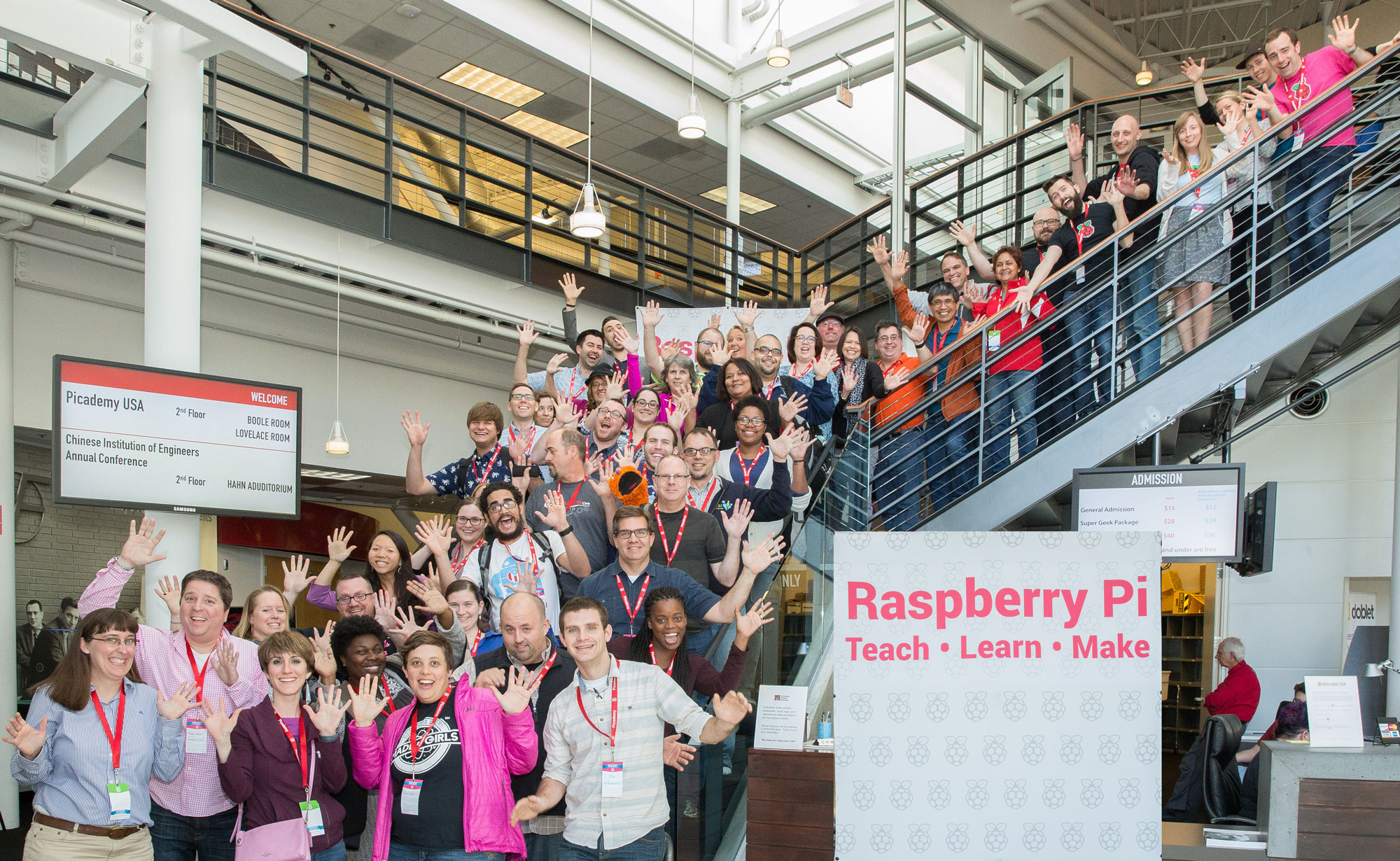
I just wrapped up a week of Picademy in Atlanta. Picademy is a two day professional development event hosted by the Raspberry Pi Foundation. It's a "free face-to-face professional development programme that supports educators throughout their digital making and computing journey". After completing the two days of awesome PD, each member becomes a Raspberry Pi Certified Educator (RCE).

 I was lucky to be part of the first North American cohort a few years ago.


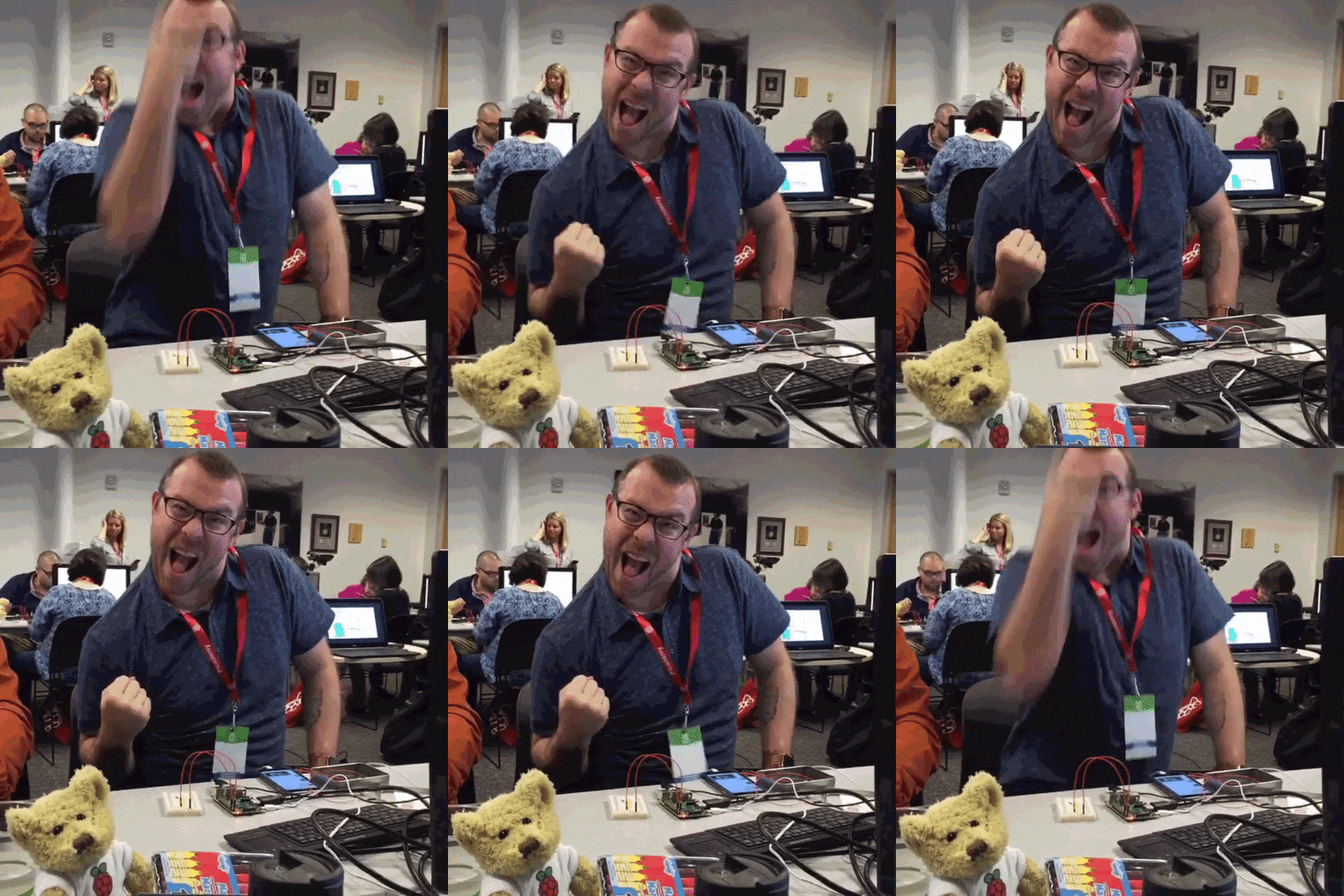
It would be easy for me to talk about it being the best PD I have every received. I'm not sure I would have written my Makerspace books if I had not attended Picademy and had the support of the community as I explored digital and physical making. Here is a GIF that still makes its rounds within the Pi Foundation that shows how much I really loved the event.


I wanted to write about the community of Raspberry Pi and how it impacts teachers around the globe. Some people do not know this, but The Raspberry Pi Foundation is a non-profit. They make these awesome computers and strive to make sure that every student has access to Computer Science. That is an amazing goal, but it is the people that truly make it so phenomenal.

For the past few years, the Raspberry Pi team in North America has grown from 2 people to 5 people. All of the events that have taken place are because of these amazing and hard working people. I have been lucky to work with them in different ways to support their mission. With the support of the amazing UK team, the North American team has done a tremendous job of creating a community of educators that, not only learn so much, but actively work to share what they have learned with other teachers and students. Teachers from across the country connect to support learning for themselves and also their students. That is such an amazing thing to create and the entire Raspberry Pi Foundation should be proud of this. 

As I said earlier, I just finished the Picademy in Atlanta and I have helped with other events in the past as well. I took some time to reflect on why I commit the time and energy to do a week long PD event. The answer came to me and it was quite simple, I love being part of the community that Raspberry Pi is building and helping grow that community as a facilitator is a great experience.

Every time I help with an event and work with teachers and/or students with Raspberry Pi, I get to learn more myself. The selfish part of the entire thing is that I get to continue to grow and learn as a physical and digital maker. It is something that is so important for my Maker Mentality. I always want to try and learn new things and teaching teachers is a great way to explore.

The community that is continuing to grow around Picademy and the Raspberry Pi Jams, is something that I am very lucky to be part of in my educational travels. Educators talk about finding their tribe and I believe you can have different tribes that support you in different ways. NErDcampMI is a tribe that nurtures my literary side and the Picademy tribe nurtures my Maker Mentality side.

I want to say thank you to Philip, Matt, Courtney, Ben, Dana, Andrew, Christina, Carrie Anne, Russell, and everyone else that has allowed me to be part of the Pi team in one way or another. You kindness and generosity has allowed an amazing community to grow and I'm thankful to be part of it.

If you want to know more about Picademyraspberrypi.org, check out the link. If you want to know more about Raspberry Pi in general, check out their redesigned site.