Thursday, March 17, 2022

#MakerEd and Wellness #MACUL22 #SEL

One of the things that people ask me about MakerEd is how does it support student wellness. Social Emotional Learning is becoming a very hot topic in education. For those of us who have been around for a while, we have always known the value of making sure students' Social Emotional needs are being met because they cannot learn unless they are. MakerEd is one of many different ways to engage students in learning and also support SEL. 
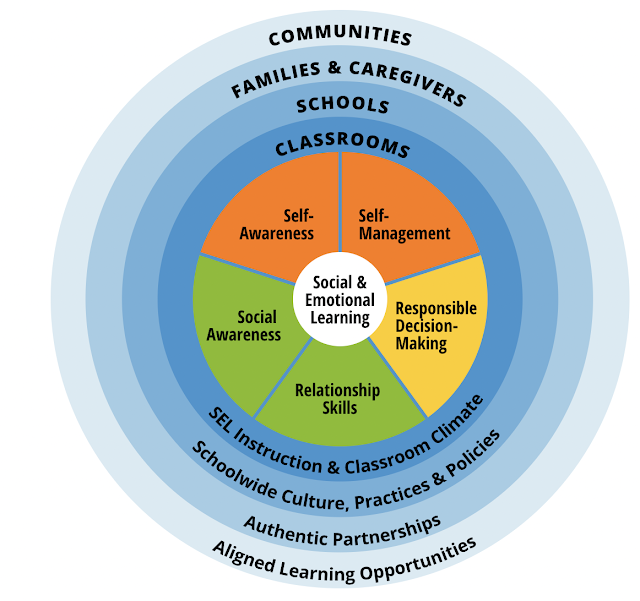
From CASEL.ORG

When we look at the framework of SEL created by CASEL, we can see that there are elements that link directly to what good MakerEd lessons and projects incorporate. Let's take a look at Responsible Decision-Making and Self-Management. 

When students are working on MakerEd projects, I emphasize the value of making good decisions about how they are going to structure their work time and how they are going to plan their project to make it possible to complete in the time allotted. Learning how to manage time for projects and how to make those decisions on their own are important skills for students to work on in school. Understanding that they will make mistakes, it is important to give them the space to make them and then coach them to learn from them and be better for the next time. 

Group projects can be messy, but it is important to work on relationship skills in class. It is important to have students work with a wide variety of peers to help them understand where everyone in a group is coming from so they can grow as learners and people. Not every project should be a group project, but there should be opportunities for students to come together and work on a project that allows multiple ideas to come together to find a solution. 

Projects can allow for students to think about the world they live in and how they fit in it. They can explore problems and consider the ways that they can help solve them on their own or with the support of others. SEL is not something that can be simply thrown into lessons and expected to make the mental health of all students better. It takes time and serious considerations to make sure that SEL is included in planning in a thoughtful manner. I've yet to find a worksheet that supported student SEL as effectively as a well crafted project. 


Monday, March 14, 2022

An Anxious Introvert's Guide to Conferences #EdChat #MACUL22

Well, conferences are back and introverts like myself are getting anxious. I will actually going to my first conference in a couple of days after a two year hiatus. My state conference, MACUL, was actually cancelled midway through because of the COVID lockdown. As I gear up for a couple of days of learning, I started to think of all of the different things I'm going to need to do to focus on my mental health as I reintroduce myself to the hustle and bustle of conference season. Here are some things for my fellow anxiety ridden friends and introverted buddies can do to help make conferences tolerable. 

1. Pace yourself

The worst thing you can do is try drinking from the firehose. Diving into a bunch of sessions and surrounding yourself with tons of strangers is exactly how you trigger an anxiety attack. Start slow and go to a session and then take some time away to think about what you did and go to the next session after the break. You need time to process and that is impossible if you are jumping from one session to the next. 

2. Hydrate yourself

Hydration is huge. For me, dehydration is a trigger for panic attacks. I have to stay hydrated so my mind can stay focused. Bring a water bottle and hit the water stations on a regular basis. Keep drinking and be ok with having to go to the bathroom often. Hydration will save from drowning in anxiety. 

3. Support yourself

Take the "me time" you need at the conference. Do not feel compelled to attend every event and engage with everyone all of the time. Bring some earbuds, listen to something that is calming, and just find your center when you feel overwhelmed. You will not be able to retain the knowledge from sessions if you are in a constant state of fight or flight. Take the time for you so you can get the most out of the session you attend during the conference. 

4. Push yourself

If you feel up for it, try and push yourself a little bit. Maybe participate a little in a session here and there or go to an event after the conference day has ended if you have the energy. As an introvert, I know how tough it can be to be surrounded by so many different people and just be overwhelmed. Dip a toe in here and there and see how it feels. Never feel bad if you need to check out because it is all too much. Your mental health is number one. Push yourself when you are ready. 

5. Reward yourself

If you spent a few days at a conference and learned a bunch, reward yourself with some "me time" away from the world. Grab a book or curl up on the couch and just veg. You have put your brain and body through a stressful ordeal and will be exhausted. Treat yourself to something awesome because you have earned it. 

For those of you who are not anxious about conferences or are extroverts, please know that everyone who is an introvert or is anxious presents very differently. Many people who assume that "The Nerdy Teacher" can't be anxious or an introvert and they would be right. "The Nerdy Teacher" is not an anxious person. "The Nerdy Teacher" is very extroverted. However, Nicholas Provenzano is a ball of anxiousness and super introverted. Putting on the "Nerdy Teacher" mask is something I do so I can cope with  the conference world and allows me to compartmentalize those anxious and introverted feelings. It is exhausting though. Any person that puts on the mask knows exactly what I am talking about. 

I share all of this because if know your friends are introverted or easily overwhelmed at events, please be understanding, kind, and supportive. When things get to be too much, we just need a friend to understand. 

Share this with your anxious and introverted friends and your extroverted friends to give them a sense of what it going on in our heads. 


Wednesday, March 9, 2022

Have you asked this question lately? #EdChat #MakerEd

 "How are you doing?"

It is a very simple question that we often think about, but, sometimes, are too busy to stop and ask our students or our colleagues. As Spring approaches and schools go on break, some students might be dreading being away from school for a whole week or more because of the turmoil in their home. Asking this simple question can be open up an important dialogue with students and peers. At a minimum, it shows the person that they are seen. I know when someone checks in on me I feel so loved. Even when things are going perfect, which is rare, it is nice to know that someone is thinking about me and wants to know how it is going. Take a moment and find some people you have not connected with lately, some students who need a check-in, or a colleague that you have not chatted with in a bit and ask that question. 


Hugs and High Fives, 

Nick

Tuesday, March 1, 2022

Reflection as Assessment #MakerEd #EdChat

One of the things that I am often asked is how I assess MakerEd work from students. The traditional education system is still grade focused. Students are taught from a very young age to chase the grade because that is what matters in the end. 

Getting students to understand that there is more to school than grades requires serious retraining on the teacher's part. It is not impossible, but it is not easy. One of the ways I have helped my students explore learning and MakerEd in my Mechanical Engineering class is the emphasis we place on reflection.

Each unit is a challenge that students need to complete. They can design their own solutions based on their research and there are goals they are trying to reach, but they are not assessed, or graded, on if they reach those goals. Their assessment is how they reflect on their work in the challenge. Here is one example, 

Students are tasked with building a bride using glue and no more than 200 craft sticks. Their bridge needs to be able to support at least 100 pounds. They will do the research and design a bridge they think will best accomplish this goal. When the bridges are done, we take the total sticks used and subtract that number from the total weight it held. The group with the highest number at the end won the challenge. 

When they have completed the testing and reviewed all of their work and the work of other groups, they are given a reflection sheet. The reflection asks students to explore why they were or were not successful. Their ability to be critical of the work, or lack there of, they put in is important. The first reflections are often the toughest for students because they are hesitant to be critical of their own work thinking it will lead to bad grades. In reality, the students that dive deeper and are critical of their decisions get the most out of class.

My job during the project time is to be engaged with the students, advise them on their choices as they work, provide feedback on their process, and support their overall needs while working. After the reflection is submitted, my job is to provide my thoughts on their thoughts. It starts a conversation about their learning process. As we move through the semester, I have found that some students are too hard on themselves and sometimes do not recognize the successes they had in the project. Students are still very new to the reflection process so I need to support them as they learn to highlight the wins and understand the loses. 

At the end of the day, I have to place a grade in the grade book. The students earn their grade through reflection and dialogue. These reflections are saved and explored at the end of the semester where they are asked to show the growth points in the class. If we truly want growth for our students, you can't have it without reflection. It is a shame that reflections tends to be the first things skipped when we run out time. 

How do you use reflection in your classes?