Showing posts with label SEL. Show all posts

Monday, August 19, 2024

Be Brave #EdChat

I wanted to share a simple post at the start of the school year. This simple post has a very simple message, 


There is so much fear out there for teachers in the classroom. They are afraid to be who they really are. They are afraid to take that risk and do that lesson that they think can make important connections for their students. There is fear to ask admin permission to try something new for the school. The world is a scary place and schools are reflecting that scariness more and more each year. It would be easy to sit and hide for the school year, but standing up and being brave can make a world of difference. Being Brave will look different for everyone. We shouldn't judge the small or large acts of bravery that teachers will show during the course of the year. Instead, we should applaud them for trying. Even if it fails, they got up and tried. I have this quote from Teddy Roosevelt in my room that really sums up my feelings on this, 

Credit: Me Made with Adobe Express

I hope everyone can find the way to Be Brave and do that thing or those things that can make the classroom or school a little better for everyone. 

Hugs and High Fives, 

NP

Monday, August 7, 2023

There's A Good Reason Some Of Your Students Are Tired At The End Of The Day #EdChat

 There's A Good Reason Your Students Are Tired At The End Of The Day And It's Not What You Think

Near the end of a long day, there are plenty of times I have looked at my classroom and seen some very tired eyes. I used to assume that these students were not eating well, stayed up too late, or other choice based behaviors that were leading to their tired appearance. It took some time for me to realize it, but some of these students are actually tired because they have been "masking" all day long. 

"Masking" is the word used to describe how neurodivergent people hide their neurodivergence from the world around them in order to fit in. Learning to mask is something that neurodivergent people learn to do at a very young age when they realize that their natural behavior does not match with with is considered "normal". It often shows itself in social situations and can lead to copying other social behaviors in an effort to fit in. Essentially, a neurodivergent spends most of their time in social situations pretending to be someone they are not to fit in and it is exhausting. 

As a neurodivergent adult, I have found myself masking often in social situations. When I tell people that I am an introvert, people think I am joking. They wonder how an introvert can present in front of large crowds of people or engage in tons of 1:1 conversations with educators, and showcase, what appear to be, very extrovert behaviors. The short answer is I was masking. My friends would see the end result of a day's worth of masking. I'm spent. Physically and emotionally. As an adult, I have learned of different ways to cope with these feelings and how not to feel pressured by society to mask who I am. Imagine a student in your class that is still learning to understand how their neurodivergence reveals itself to other students who might not understand and/or have empathy to what they are experiencing. 

Students that mask in class are very difficult to identify. The older they are, the harder it is to see behind the mask because they have gotten very good at it. There are a couple of things you can do as a teacher to help those students who are masking feel more comfortable taking off that mask in class and feeling like their true selves. 

1. Explore and Discuss SEL

It is important that teachers take the time, as a school or as an individual, to understand SEL and how it can support our students. CASEL is one of the best resources out there to get a better understanding of SEL. Just knowing that their teachers are working on different ways to support students and their mental health can make a masked student start to feel more comfortable being who they are in the open. Like many things, it starts with educating ourselves to better understand who we are an who people are that surround us. If you really want to support students who struggle in your class because they are neurodivergent, start exploring SEL and see how it can change the culture of your classroom. 

2. Share your Neurodivergent Story (If You Are Comfortable)

I have found that sharing my neurodivergent traits (Anxiety and dyslexia to name just two) leads to students being more open with their traits. There is at least one student in every class that will say "Me too!" when I mention I am dyslexic. It is important to normalize neurodivergence in the classroom. I spent too much time growing up feeling I was just stupid because I could not read like everyone else. If you are not a neurodivergent teacher or do not feel comfortable sharing your neurodivergence with your class, that is fine. We are all on our own journey of understanding and I do not want to pressure you into sharing your experience until you are ready. 

Sharing with students that there are lots of different types of learners in class at the start of the year and that you are going to work to make sure that everyone feels supportive is a nice way to open the door for those neurodivergent students who might need an invite to share who they are and how they learn. 

3. Embrace Differentiation 

Yes, it will take more time and that is the most pressure resource of all educators, but a little more time to differentiate for those students who are masking to hide their neurodivergence is so important if we want them to succeed. The best way to have students take off their mask is to create an environment where they feel comfortable and are able to succeed while utilizing their strengths. Traditional assessments and class structures tend not to support neurodivergent students and that is why they mask.

I could never read all of the pages assigned in a night for most of my high school classes. I would do my best, but I could not get through it. So, I would often listen to the first 10-15 minutes of class, understand what the topic of discussion was, and just through in my two cents by just rephrasing what other students said. It appeared like I had read and that I knew what was going on in the story. That helped me get through high school in many of my classes. As long as I was never cold called (Don't do it! It's one of the worst teaching practices!), I could mask all day in class. 

Offering students different ways to access the curriculum of the class and different ways to assess their understanding are great ways to make masking students feel more comfortable in class. They will not have to wear their mask if they know they are can explore who they are with the material covered in class. 

Masking takes so much energy from a person. A student who has to mask all day does not want to go home and do homework. They do not want to engage with their family. The often want to zone out playing video games, watching videos they have seen over and over again, and just be left alone. They just don't have it in them to put the mask back on at home and that sometimes leads to angry outbursts and lots of resistance to being asked to do anything. They were just "forced" to were a mask all day and now they just want to be themselves. Alone. 

Making small changes in the classroom to support neurodivergent students can go a long way in helping them be successful as they work through understanding their neurodivergence and how best to navigate society. I don't think we can expect to get to a point where these students will never wear a mask, but would should strive to create a space where they can take it off and breathe a little easier once in a while. 


Hugs and High Fives, 

N Provenzano
 

Note: Images created using Generative AI from Adobe Firefly

Thursday, January 5, 2023

Be Brave #EdChat


The new year will bring new challenges and this song is going to be one of my many anthems to help me be successful. For all of the educators out there that are feeling run down and are not sure what is next, sometimes, the only thing we can do is be brave, speak up, and do what is best. 

I encourage you to be brave and try that new project or switch some lessons around like you have always wanted. There is a chance you will fail and that is ok. Failure is part of being brave. I might not know you, but I believe in you. You can do it. Be brave. 

The best things in life are hard and being brave is the first step in making change. I hope all of you out there can make the changes you want for 2023 and know you are not alone. An entire community of educators are out there that will help if you are struggling. 

Sending you the biggest hugs and high fives!

Bravely, 

The Nerdy Teacher

Thursday, September 15, 2022

It's Just A Phase #MakerEd #EdChat

I was thinking about the phrase, "It's just a phase" the other day after watching someone say it on a show I was watching. The phrase is funny to me. It is said as if it is not a big deal, but I think that is wrong. I think going through a phase is a big deal and we should encourage students and adults to go through them. Follow me on my logic here, 

A phase is a time where a child is trying something new. This could be a new style of clothing or possibly a new type of music (90's Swing Music anyone?). They will explore this new identity or hobby and claim it is who they are now. Instead of telling kids they are wrong or they will grow out of it, I think it should be encouraged. Exploring and trying new things is not easy. This is something that should be supported because you will never know what you love or don't without experimentation. If you have taught long enough, you have seen students evolve over the years because they try on many different hats. It is a fun conversation to have with them when they get older because they, like many of us, are embarrassed by their phases. I have some great pictures of me with tremendous 90210 inspired sideburns. We shouldn't be embarrassed. We should be proud that we tried something out that made us happy at the time. 

As teachers, I think it is easy to dismiss new pedagogical approaches as fads or just a phase another teacher is going through at the moment. There are plenty of things I have tried that I no longer do. I'm not embarrassed but them. I use them as points of growth along my educational journey. They are examples of where I have tried something to better support my students. I either do it because it is great, don't do it because there is something better, or I don't do it because it does not work how I want it to. Not matter the reason, I tried it for myself and I'm glad I tried it. 

The next time you think that someone is just going through a phase, also think about how you can cheer them on as they explore something new. 


Hugs and High Fives, 

N Provenzano

Monday, May 2, 2022

Ugly Stuffy Project #MakerEd

I've been looking for a new project for students this trimester and I was just at home thinking about the different things I wanted students to do. I knew I wanted them to make something with their hands, but I wanted to make it silly and ok if they were not "good" at it from the start. It was while I was watching Antman and the scene where he gave his daughter the creepy doll struck me. Ugly Dolls are are a thing and I think they can be a pretty simple project. I jumped online, found a bunch of videos on how to make these dolls and set to work ordering supplies and giving it a try myself. This has been a fun project because the Stuffys are supposed to look off and ugly. No mistakes, only features. Even in my demo I made that you can see below. I thought the fangs would be cool, but I made them too thin to sew and I didn't have the fabric glue. I pivoted and used excess fabric to make a mouth. It turns out I made plankton from Spongebob Squarepants, but I made him on my own. I just tasked the students with making an Ugly Stuffy, but I could give them more guidance and ask them to create a symbol of a feeling or something like that. There are lots of possibilities with a project like this. If you are looking for a project that will take a couple of days and get the students crafting with their hands, give the Ugly Stuffy project a try. 

My Steps - Made with Adobe Creative Cloud Express

Supply List

Poly Fil 

Embroidery Floss 

Scissors

Felt

Buttons

Needle Threaders

Glue

Large Needles

Students got to work and some had sewing experience and were able to help me and others do a better job. Here is a collection of photos from my Instagram account. 


Follow along on my instagram to see the Ugly Stuffys that students finish this week. 


 Hugs and High Fives, 

The Nerdy Teacher

Thursday, April 21, 2022

Coloring and #MentalHealth #EdChat #SelfCare

As we wind down the school year, the stress levels for students tend to shoot up through the roof. One of the things that I have found to be wonderfully helpful in mitigating that stress is something so simple and something that all kids love to do, coloring. 

That's right, coloring is great for mental health. Don't believe me, check out this article from the Mayo Clinic and this article from the Cleveland Clinic on why coloring is good for children AND adults. I offered coloring to my students the other day and almost every single one took me up on the offer and they sat, talked, and colored. It was such a nice and calming moment in class. 

If you are looking for some coloring resources, you can check out the ones below. 

Supercoloring

Coloringhome (Warning: Some pages are NSFW, but they have lots of kid options.)

From ColoringHome.com


For the mental well-being of your students and yourself, take a break and color something beautiful. You will feel so much better if you do. 


Hugs and High Fives, 

N Provenzano

Friday, April 8, 2022

I'm Neurodivergent. Would I be successful in your class? #EdChat

Over the past few years, there has been more talk about Social Emotional Learning. As part of that conversation, many educators are hearing new terms. One of those terms is neurodiversity. 

Neurodiversity can be described as the fact that different people experience the world around them in different ways. 

As a teacher, we have always known that our classroom was filled with students that approached learning in different ways. We were always tasked with differentiating our instruction to support those students. However, with more research being spent on brain science and the act of learning, we are understanding neurodiversity much more. 

Two terms that have become more common place are "neurotypical" and "neurodivergent". These are relatively new terms. So much so, that the spell check on Blogger is telling me I am spelling them wrong. A neurotypical person is best described as someone who interacts with society in ways that are acceptable to agreed upon social constructs. A traditional, but very antiquated, word to describe these folks would be "normal". 

Neurodivergent people (Me!) are the opposite of neurtypical people. Their approach to learning and processing tends to go against the accepted views of societies or educational institutions. People that have dyslexia and ADHD are a few examples of the types of neurodivergent people out there.  The more I learned about being neurodivergent, the better I felt about myself. So many of my past and current struggles were able to be understood from the lens of neurodivergency. Once I understood it better, I was able to own it. I was able to be empowered by it. I no longer viewed my neurodivergence by my learning deficiencies, but through the special ways I do learn. 

It can be very hard for a neurdivergent person or student to "fit in" to a structure or system that was designed for and by neurotypical people. The more I have learned about my on neurodivergent behaviors, the better I have been in understanding the neurodiversity in my classroom. You would be hard pressed to find a classroom that did not have some neurodivergent students. Those students can often be overlooked or labeled as "busy bodies", "day dreamers", "quiet types", and more because they do not fall into the neurotypical definition of a student. This has to change for our students. 

One of the things I have been able to do as a neurodivergent person is share the fact that I am neurodivergent with students. I will mention that I have ADHD and that I manage dyslexia. I have found that the more that I have shared, the more that students have spoken up about how they are neurodivergent. Creating a safe space that allows for students to feel comfortable with who they are is key to any classroom. 

There are are some things that you can do to support a neurodiverse classroom,

  • Talk about neurodiversity in class and what it means
  • Allow for fidget devices and/or bring in wobble chairs
  • Let students stand or move around the classroom during a lesson when appropriate 
  • Avoid sarcasm
  • Provide written directions whenever possible
  • Break projects into smaller chunks with check-in points
  • Talk to students who are neurodivergent and see what they need
These are just some strategies on helping neurodivergent students in your classroom. I recommend doing some reading on the topic as well to really further your understanding of neurodiversity in your classroom. 

Check out the Stanford Neurodiversity Project for more information. 

Hugs and High Fives, 

Neurodivergent Nerdy Teacher

Thursday, March 17, 2022

#MakerEd and Wellness #MACUL22 #SEL

One of the things that people ask me about MakerEd is how does it support student wellness. Social Emotional Learning is becoming a very hot topic in education. For those of us who have been around for a while, we have always known the value of making sure students' Social Emotional needs are being met because they cannot learn unless they are. MakerEd is one of many different ways to engage students in learning and also support SEL. 

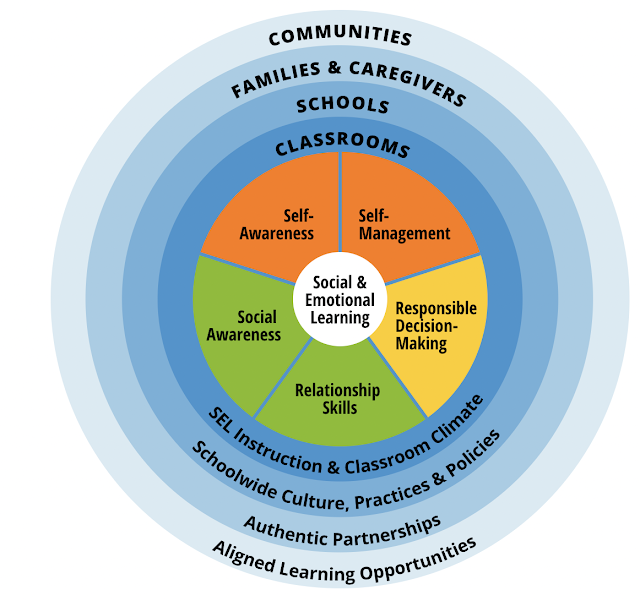
From CASEL.ORG

When we look at the framework of SEL created by CASEL, we can see that there are elements that link directly to what good MakerEd lessons and projects incorporate. Let's take a look at Responsible Decision-Making and Self-Management. 

When students are working on MakerEd projects, I emphasize the value of making good decisions about how they are going to structure their work time and how they are going to plan their project to make it possible to complete in the time allotted. Learning how to manage time for projects and how to make those decisions on their own are important skills for students to work on in school. Understanding that they will make mistakes, it is important to give them the space to make them and then coach them to learn from them and be better for the next time. 

Group projects can be messy, but it is important to work on relationship skills in class. It is important to have students work with a wide variety of peers to help them understand where everyone in a group is coming from so they can grow as learners and people. Not every project should be a group project, but there should be opportunities for students to come together and work on a project that allows multiple ideas to come together to find a solution. 

Projects can allow for students to think about the world they live in and how they fit in it. They can explore problems and consider the ways that they can help solve them on their own or with the support of others. SEL is not something that can be simply thrown into lessons and expected to make the mental health of all students better. It takes time and serious considerations to make sure that SEL is included in planning in a thoughtful manner. I've yet to find a worksheet that supported student SEL as effectively as a well crafted project. 


Wednesday, May 6, 2020

How Often Are You Checking On The SEL Of Your Students? #EdChat

As the epidemic continues and teachers and students are still engaging in remote learning, how often does SEL come up?

Right now, I have seen too many articles about the knowledge slide that students are going to experience this year. When it comes to content and curriculum, students are going to be fine! Teachers will adjust the curriculum and students will be able to continue to learn. These views are stuck in the antiquated view of what school needs to be. Grades, pathway to college, and homework should not be the main focus on school right now.

Right now, teachers should be trying to engage students as best as they can with content, but they should also be checking on the mental health of their students by making sure time is given for students to connect with one another online. Let the students share their favorite stories or binge worthy shows. Play games using Kahoot! or Gimkit. Ask about something new they have done at home. Ask for book recommendations. For some students, connecting with their class is the only connection they have with other people outside of their home. We need to try as best as we can to support our students beyond the grade book. 

Here is a great article from EdWeek that is worth reading that covers SEL and Remote Learning. I hope everyone involved with remote learning will take a moment and assess the wellbeing of their students before giving out the next assignment.